
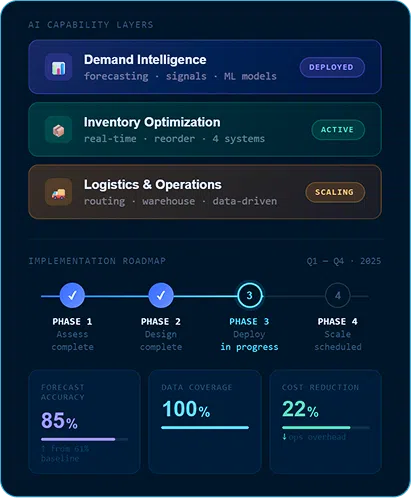
AI for Modern Supply Chain Operations

Implement AI systems across planning, inventory, and logistics to improve operational visibility, forecasting accuracy, and supply chain decision-making.

12+

Years Building Supply Chain Systems

99%

Supply Chain Visibility

30%

Inventory Cost Reduction

Legacy Supply Chain Systems Challenges

Legacy Supply Chain Systems Limit AI Adoption

Outdated system logic, disconnected workflows, and fragmented data limit AI adoption across supply chain operations.

Disconnected Data Across Systems

Data remains fragmented across ERP, WMS, and external sources, limiting the ability to build reliable, unified models.

Static Planning Systems

Planning processes rely on batch updates and fixed rules, preventing continuous adjustment based on changing demand and supply conditions.

Limited Execution Integration

Model outputs often remain isolated, with no direct path to execution within operational workflows and decision systems.

Low Data Readiness for Modeling

Inconsistent data structures and missing pipelines reduce model accuracy and make ongoing model maintenance difficult.

Lack of Feedback Loops

Operational outcomes are not captured and fed back into systems, limiting continuous learning and performance improvement.

– AI Supply Chain Consulting Services

AI Layer Integrated Into Supply Chain Systems

We implement AI layers on top of existing systems such as ERP, WMS, and planning tools to improve decision-making and operational efficiency.

AI Integration for ERP, WMS & Planning Tools

Integrate AI layers to existing systems for  real‑time inputs, workflow execution, no infrastructure replacement.

Predictive Forecasting & Inventory Planning

Machine learning using historical and real‑time data to improve forecast accuracy and inventory decisions.

Real‑Time Decision Support

Actionable recommendations for supply, inventory, and logistics operations for better decision-making.

Generative AI Agents for Operations

AI agents handle workflows, team planning, exception handling, reporting, and support.

Data Pipelines & Model Infrastructure

Deploy, monitor, and maintain models for reliable AI performance and data-driven execution over time.

Legacy Supply Chain AI Enablement

Assess existing systems, data quality, and operational constraints, then phase in AI capabilities without disruption.

AI Use Cases in Supply Chain

Where AI Improves Supply Chain Operations

Demand Forecast Accuracy Improvement

Improve forecast reliability using historical and real-time data, reducing stockouts and excess inventory across planning cycles.

Inventory Optimization Across Locations

Balance inventory levels across warehouses and distribution points to maintain service levels while reducing holding costs.

Automated Demand and Supply Planning

Continuously adjust supply plans based on demand signals, constraints, and operational changes without manual intervention.

Warehouse Operations Optimization

Improve picking efficiency, labor allocation, and throughput using predictive models and workload forecasting.


AI That Works Inside Your Current Systems

No rip‑and‑replace. Add AI to planning, inventory, and logistics, run alongside ERP, WMS, and tools.

Frequently Asked Questions

Start with high-impact areas such as demand forecasting, inventory optimization, or logistics. Focus on use cases with clear data availability and measurable outcomes.

Yes. AI solutions are integrated with ERP, WMS, and other systems to support operational workflows without replacing existing infrastructure.

We develop and deploy initial use cases within weeks, depending on data and system complexity.

Supply chain companies typically improve forecast accuracy, reduce inventory costs, and increase operational efficiency across planning and execution.

Clean data improves results, but most implementations begin with existing data and improve data quality over time.