
Nine out of ten enterprises have launched an AI project. Only four out of a hundred have extracted measurable business value from one.
That gap is not a technology problem. The models work. GPT-4, Claude, Gemini, and their enterprise variants are genuinely powerful. The problem is everything that surrounds the technology: unclear objectives, unprepared data, absent governance, and leadership decisions made without a coherent strategy. That is precisely the gap AI consulting exists to close.
This guide covers what AI consulting actually is, what a qualified consultant delivers, the types of services available, how a real engagement unfolds, and what to look for when selecting a partner. Whether you are a CTO asking foundational questions or a VP of Engineering evaluating vendors, what follows is designed to give you a precise, research-backed answer.
What Is AI Consulting?
AI consulting is a specialized professional service that helps organizations plan, design, implement, and optimize artificial intelligence solutions in alignment with specific business outcomes. It combines technical expertise in machine learning, data engineering, and AI infrastructure with strategic advisory on use case prioritization, governance frameworks, change management, and measurable ROI delivery.
In practical terms, AI consulting answers three questions that most organizations cannot answer internally: Where should we apply AI to create the most value? How do we build it in a way that is scalable and responsible? And how do we ensure our people and processes are ready to sustain it?
The Hackett Group defines it as advisory that “identifies high-impact use cases, assesses readiness, and develops tailored AI roadmaps” guiding clients “through model selection, data strategy, governance, risk management, and change enablement.” That framing is accurate, though incomplete. In practice, the consultant’s most important job is not drafting a roadmap. It is ensuring that the roadmap gets executed and that the organization retains the capability to keep building after the engagement ends.
What Does an AI Consultant Actually Do?
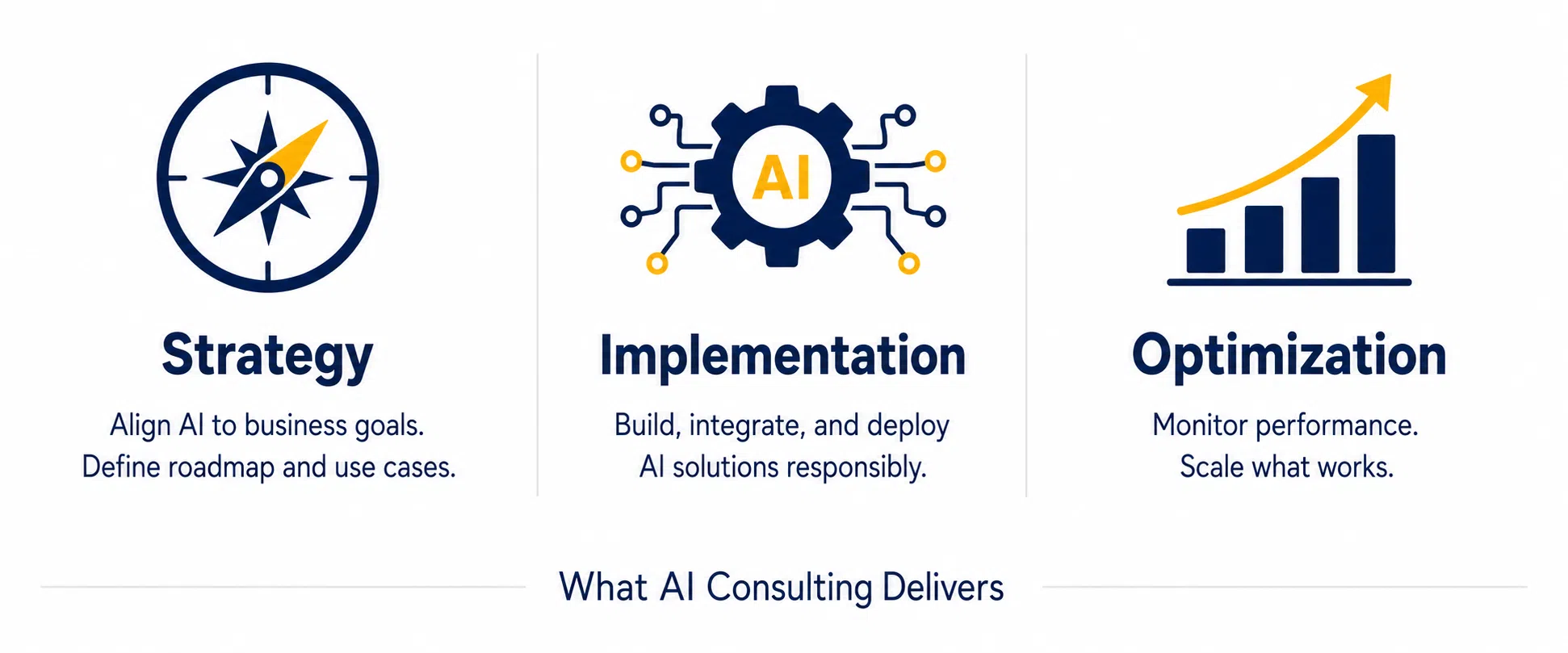
The role of an AI consultant is considerably more hands-on than the word “advisory” suggests. A qualified consultant does not arrive with a generic framework, rename it with your company’s logo, and leave. The work spans assessment, architecture, implementation, and organizational change, often simultaneously.
At the assessment stage, a consultant evaluates your data infrastructure, technology stack, team maturity, and existing workflows to determine what is actually AI-ready and what is not. This produces a concrete readiness scorecard rather than a vague summary. According to a 2025 Forbes analysis, 60 to 70 percent of enterprise AI failures trace back directly to unprepared data infrastructure, so this phase alone prevents the majority of downstream failures.
From there, the consultant defines a phased roadmap: which use cases to prioritize, in which order, with which success metrics, and at what budget. A capable consultant will also advise on build vs. buy decisions, helping you choose between fine-tuning a foundation model, deploying an off-the-shelf solution, or building a custom AI system from the ground up.
During implementation, the consultant works alongside your engineering and business teams to deploy models into live workflows, integrate them with your existing systems, manage data pipelines, and address security and compliance requirements. Post-deployment, the work shifts to monitoring model performance, detecting drift, retraining systems as conditions evolve, and tracking KPIs against the original roadmap.
Perhaps the most underestimated function is change management. AI does not operate in isolation from the people who use it. An effective consultant designs training programs, communication strategies, and stakeholder alignment processes that turn potential resistance into organizational buy-in. As HBR’s 2025 analysis of the consulting industry noted, the emerging model rewards consultants who can act as engagement architects, translating AI outputs into strategic decisions, not just technical implementers.
The deliverables you should expect from an AI consulting engagement include an AI opportunity matrix, a readiness scorecard, a phased implementation roadmap, a governance and responsible AI framework, a defined set of KPIs, integration documentation, and change management assets for your internal teams.
Types of AI Consulting Services
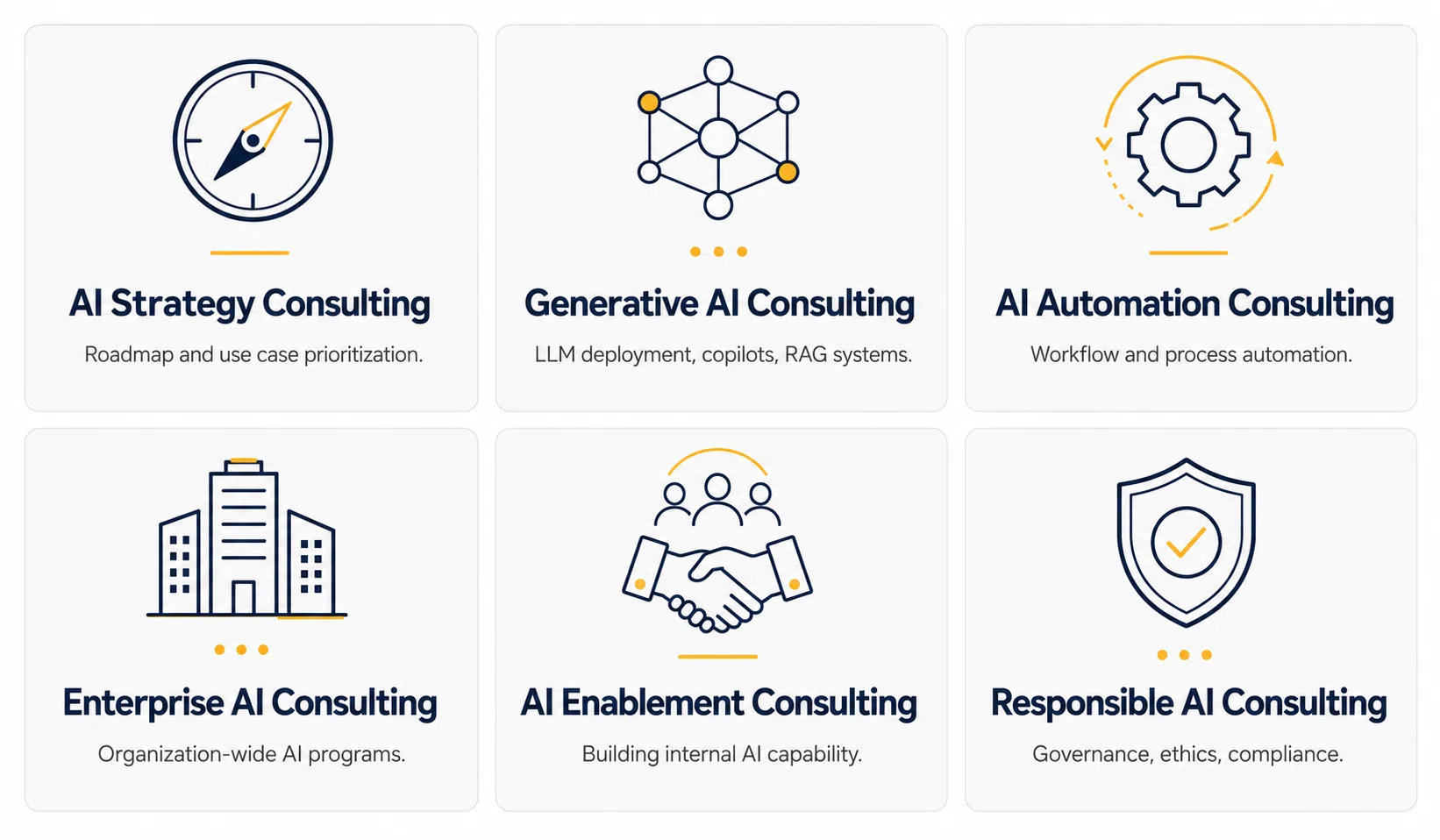
The term “AI consulting” covers a broad spectrum of services. Understanding the distinctions matters when evaluating what your organization actually needs.
AI Strategy Consulting focuses on the “what” and “why” before any technology is selected. Consultants in this category help leadership teams define their AI vision, map opportunities to business objectives, assess competitive positioning, and build a multi-year roadmap. This is typically where an engagement begins, particularly for organizations that are early in their AI journey.
Generative AI Consulting has become its own distinct service category since 2023. It focuses specifically on large language models, image generation, code generation, and multimodal AI. Engagements in this area include designing prompt engineering frameworks, building retrieval-augmented generation (RAG) systems, deploying enterprise copilots, and creating guardrails for safe generative AI use. According to BCG’s 2026 AI Radar, companies plan to double their AI spend in 2026, and a significant portion of that is directed at generative AI initiatives.
AI Automation Consulting targets specific operational workflows: document processing, customer service automation, supply chain optimization, or financial reconciliation. The goal is identifying which manual, rule-based processes have the data volume and consistency to benefit from intelligent automation, then replacing or augmenting them systematically.
Enterprise AI Consulting operates at organizational scale. Rather than optimizing a single workflow, enterprise-level engagements redesign how AI operates across multiple business functions, often running parallel workstreams in operations, finance, HR, and customer experience simultaneously. These engagements require strong program management, executive alignment, and a long-term capability-building agenda.
AI Enablement Consulting is often confused with AI strategy consulting, but the focus is different. While strategy defines where AI should go, enablement focuses on organizational readiness: upskilling teams, establishing AI centers of excellence, building internal tooling, and creating governance structures that allow the organization to operate AI independently over time. The objective is transferring capability, not sustaining dependency on external consultants.
Responsible AI Consulting addresses governance, ethics, bias mitigation, and regulatory compliance. As legislation such as the EU AI Act, proposed US federal AI standards, and state-level regulations mature, organizations face documented risk assessments, algorithmic audits, and human-in-the-loop requirements. Responsible AI consulting builds the frameworks and oversight processes needed to meet these standards while maintaining operational speed.
Shadow AI Governance Consulting is the newest service category and among the most urgent. Shadow AI refers to AI tools employees adopt without IT authorization or governance oversight, such as personal ChatGPT accounts, browser plugins, and third-party AI writing tools used to process proprietary data. A Deloitte 2025 survey found that more than half of enterprise employees report using AI tools that are not sanctioned by their organization. Shadow AI governance consulting identifies this exposure, quantifies the risk, and builds practical policies that manage it without blocking productive AI use entirely.
The 5 Phases of an AI Consulting Engagement
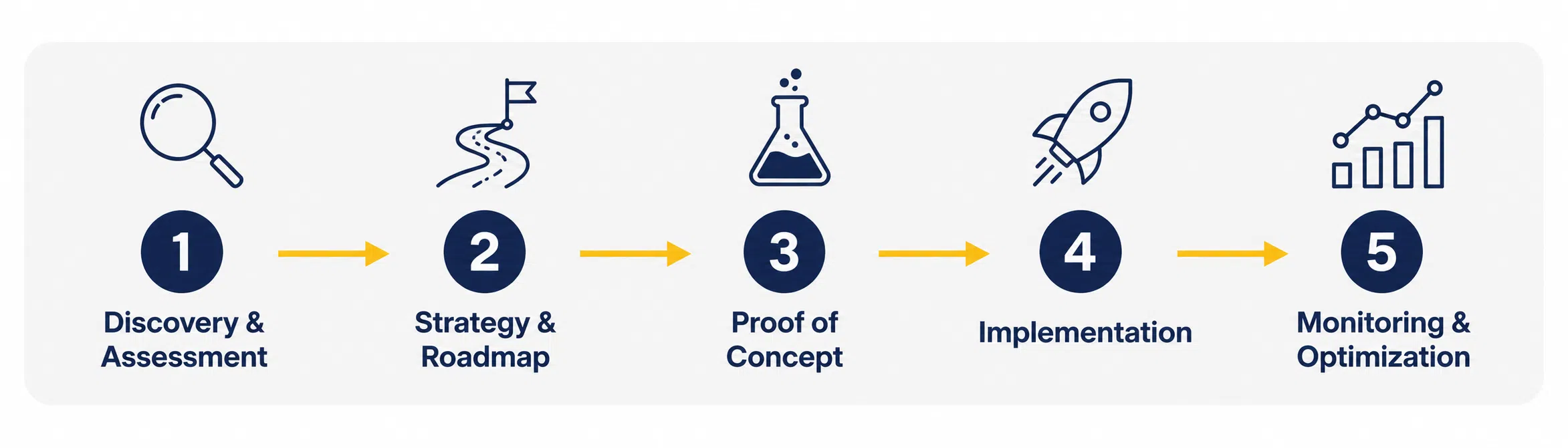
Regardless of service type, a well-structured AI consulting engagement follows a consistent progression. The phases are not rigid checkboxes; they overlap and iterate. But organizations that skip or compress early phases almost always pay for it in later ones.
Phase 1: Discovery and Assessment. The consultant evaluates your current data quality, infrastructure, existing AI/ML tooling, team capabilities, and business priorities. This is not a checkbox exercise. The output is a concrete picture of where you are starting from, including gaps that would cause a project to fail if unaddressed before launch.
Phase 2: Strategy and Roadmap. Based on the assessment, the consultant works with leadership to define specific use cases, prioritize them by value and feasibility, set measurable OKRs and KPIs, and design a phased implementation plan. Budget allocation, governance requirements, and build vs. buy decisions are all resolved here.
Phase 3: Proof of Concept. A controlled pilot tests the highest-priority use case in a real environment using real data. The POC validates technical assumptions, surfaces integration challenges, and produces early evidence of business value. This is where organizations learn whether the underlying data actually supports the AI use case, a discovery that often requires course correction before scaling. A typical POC runs six to twelve weeks.
Phase 4: Implementation and Integration. The validated solution is deployed into production workflows. The consultant manages model integration with existing systems, data pipeline configuration, security controls, user training, and change management. This phase requires both technical depth and organizational fluency because the most technically correct deployment can still fail if the people it affects are not prepared to use it.
Phase 5: Monitoring and Optimization. After deployment, ongoing MLOps practices track model performance, detect data drift, retrain models as conditions change, and measure outcomes against the original KPIs. This phase is what separates a one-time implementation from a sustainable AI capability. The consultant should be working themselves out of this role by transferring monitoring responsibilities to your internal team.
Why 95% of Enterprise AI Projects Fail Without Expert Guidance
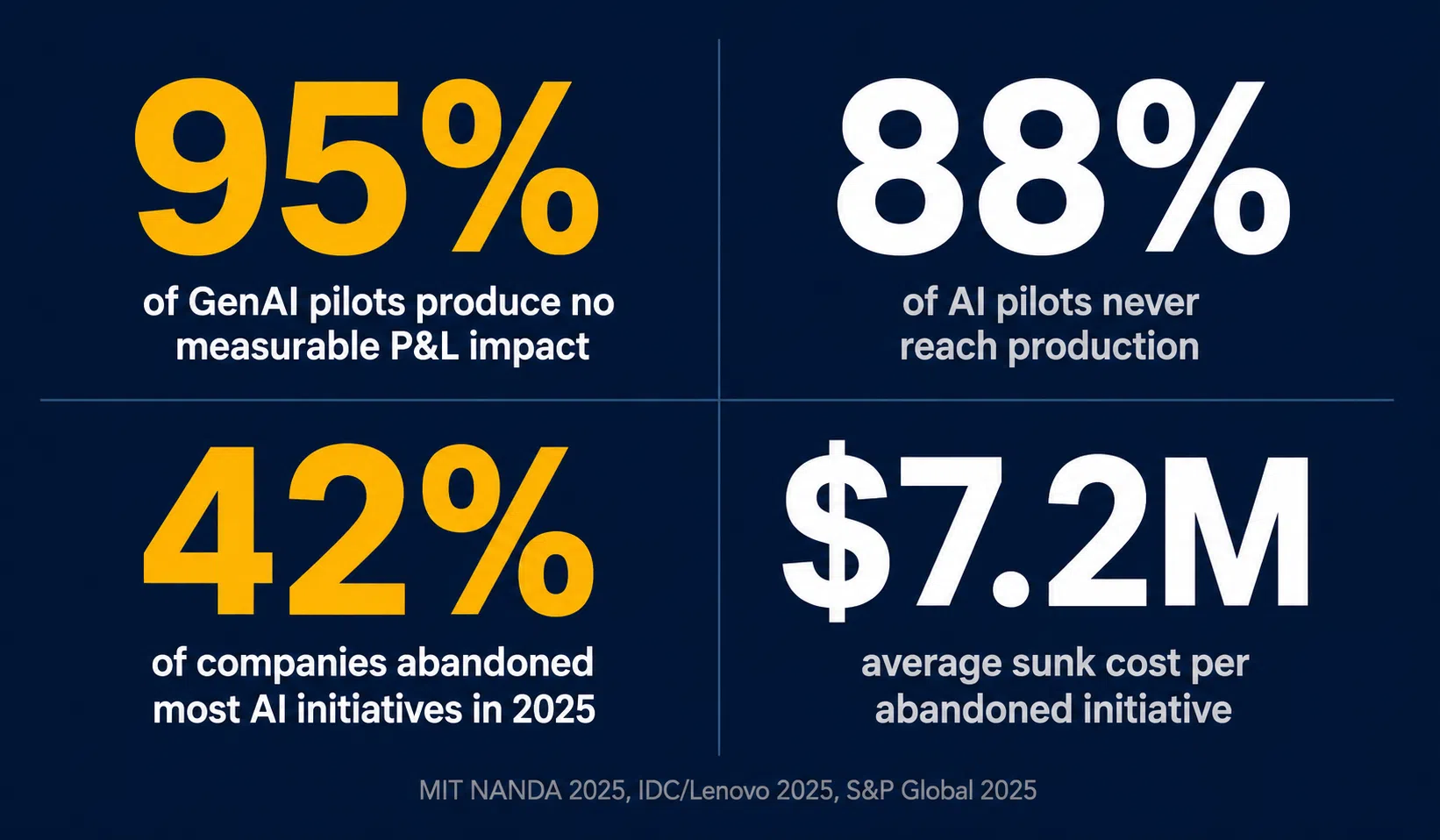
The failure statistics for enterprise AI are not soft disappointments. They are a systematic crisis that costs organizations billions of dollars annually while producing nothing measurable on the income statement.
MIT’s 2025 NANDA initiative, drawing on 300-plus real deployments and 150-plus executive interviews, found that 95 percent of enterprise generative AI pilots produced no measurable profit-and-loss impact. IDC and Lenovo’s AI CIO Playbook 2025 found that for every 33 AI proofs of concept an enterprise launches, only four reach production. S&P Global’s Voice of the Enterprise survey found that the share of companies abandoning most of their AI initiatives jumped from 17 percent in 2024 to 42 percent in 2025. The average sunk cost per abandoned large enterprise AI initiative is $7.2 million.
The cause is rarely the AI itself. The recurring failure modes are consistent across industries and company sizes: unclear success definitions, weak data foundations, poor integration into actual workflows, absent executive sponsorship past the pilot phase, and no governance framework. These are organizational problems that no model upgrade will solve.
This is the precise context in which AI consulting delivers its most critical value. A seasoned consulting team prevents the most expensive mistakes before they happen: scoping a pilot against business outcomes rather than technical novelty, auditing data quality before a model is trained on it, designing success metrics that measure P&L impact rather than usage volume, and building the governance framework that ensures the organization can sustain what it deploys.
A McKinsey 2025 survey found that only seven percent of organizations had fully deployed and integrated AI across their enterprise, despite 65 percent claiming to be experimenting. Centric Consulting’s research corroborated this: 60 to 70 percent of AI growing pains originate from inadequate data infrastructure, a problem that skilled consultants address before a single model is trained. Centric helped one regional bank move from zero automation to giving 67 percent of customers a fully automated end-to-end experience by systematically aligning culture, process, and technology through a structured engagement.
AI Consulting vs. AI Enablement: Understanding the Difference
These two terms are often used interchangeably. They describe meaningfully different things, and confusing them leads to buying the wrong type of engagement.
AI consulting, as defined throughout this guide, covers the full spectrum from strategy through implementation. It includes technical delivery alongside advisory. A consulting firm may implement an AI system for you, integrate it with your infrastructure, and then hand it over.
AI enablement consulting, by contrast, is not primarily about delivering AI systems. It is about building your organization’s internal capacity to develop, deploy, and govern AI independently. An AI enablement engagement might include training programs, internal AI center of excellence design, tooling selection, prompt engineering workshops for your development teams, and governance framework design. The output is an organization that is less dependent on external consultants, not more.
The right engagement often combines both. A phased approach might begin with strategy consulting to define the roadmap and deliver initial implementations, then transition into enablement work that builds internal capability to sustain and extend what was built. The consulting dependency trap, where organizations cannot sustain or extend what a consultant built because the capability left with the engagement, is one of the documented contributors to the failure statistics above. A capable partner explicitly designs against that outcome.
What to Look for When Choosing an Enterprise AI Consulting Partner
The AI consulting market has grown from $7.4 billion in 2025 to an estimated $9 to $14 billion range in 2026, depending on the research source, with projections placing it above $70 billion by 2034. That growth has produced both specialized excellence and considerable noise. Evaluating a partner seriously requires moving past credentials and case study summaries.
Industry specificity matters more than general AI capability. A consultant who has delivered AI implementations in your sector understands the data structures, regulatory environment, workflow patterns, and organizational culture specific to it. Retail AI looks nothing like manufacturing AI, which looks nothing like financial services AI. Ask for case studies in your vertical, then ask for references you can call.
End-to-end delivery capability separates firms that advise from firms that deliver. Strategy without implementation is an opinion document. Implementation without strategy produces solutions that solve the wrong problems. Look for a partner that has genuine in-house capability across the full lifecycle: data engineering, model selection and fine-tuning, cloud infrastructure, integration, governance, and change management.
Governance and responsible AI fluency is no longer optional. With the EU AI Act in force, US state-level AI legislation accelerating, and organizations facing 42 percent abandonment rates partly driven by inadequate risk controls, a partner that cannot articulate a responsible AI framework for your specific use cases and regulatory context is a liability. The partner should be able to demonstrate how they handle bias detection, data privacy, model explainability, and audit trails.
Transparency in measurement is the clearest signal of confidence. A partner who is reluctant to define KPIs, ROI projections, or success criteria before the engagement starts is telling you something important. Align on what measurable success looks like on day one, then hold the engagement to it.
Capability transfer intent matters because the engagement will eventually end. Ask the partner directly how they structure knowledge transfer, documentation, and internal team upskilling. Their answer tells you whether they are building your capability or sustaining their own relevance.
For a detailed framework on evaluating partners specifically for custom AI development, see our guide on how to choose an AI development partner.
How Much Does AI Consulting Cost?
Cost varies significantly based on scope, engagement length, data maturity, and the type of consulting required. Broad ranges are more useful than false precision here.
Strategy-only engagements, covering assessment, roadmap, and use case prioritization without implementation, typically range from $25,000 to $150,000 depending on the size of the organization and depth of the assessment. Discovery and assessment phases as standalone work often fall between $15,000 and $50,000.
Proof-of-concept engagements that include a working pilot typically range from $50,000 to $250,000, again depending on data complexity, integration requirements, and whether custom model development is involved.
Full enterprise AI transformation programs with multi-workstream implementation, change management, governance framework design, and MLOps capability building operate in the $500,000 to $5 million-plus range on an annual basis for large organizations.
ROI benchmarks from implemented projects are more instructive than cost ranges. Automation in insurance claims processing has reduced handling times by up to 50 percent. Predictive analytics implementations have improved sales forecasting accuracy by 35 percent or more. The Fortune Business Insights market analysis notes that organizations achieving positive ROI do so typically within 12 to 18 months of a well-structured engagement.
Cost should not be evaluated in isolation from the cost of failure. At an average sunk cost of $7.2 million per abandoned enterprise AI initiative, according to CIO research, a well-scoped consulting engagement that prevents even one failed implementation pays for itself many times over.
What Shispare’s AI Consulting Approach Delivers
At Shispare, AI consulting is built around a single governing principle: strategy without implementation is overhead. We work with mid-to-large enterprise teams across manufacturing, financial services, healthcare, and technology to move from AI ambition to measurable production outcomes. Our engagements are structured to assess your readiness honestly, design a roadmap aligned to your specific business objectives, and deliver implementations that your internal teams can sustain and extend independently.
If you are evaluating where your organization stands before committing to a full engagement, the best starting point is a structured AI readiness assessment.
Start Your AI Readiness Assessment
Frequently Asked Questions About AI Consulting
What is AI consulting and how does it differ from hiring an AI developer?
AI consulting covers the full advisory and implementation spectrum: assessing readiness, defining strategy, prioritizing use cases, designing governance frameworks, and managing change alongside technical delivery. Hiring an AI developer addresses one part of that, which is building the system. Consulting addresses all the organizational, strategic, and operational questions that determine whether the system delivers business value once built. Many enterprises need both, but they solve different problems. A consultant without development capability produces a roadmap. A developer without consulting context often builds the wrong thing correctly.
What is the difference between AI consulting and AI enablement consulting?
AI consulting encompasses the full lifecycle from strategy through delivery. AI enablement consulting focuses specifically on building your organization’s internal capacity to operate AI independently: training teams, designing AI centers of excellence, selecting internal tooling, and establishing governance processes. Enablement is often the second phase of a mature AI program, following an initial consulting and implementation phase. The goal of enablement is explicitly to reduce the organization’s dependence on external consultants over time.
What is enterprise AI consulting and who needs it?
Enterprise AI consulting operates at organizational scale rather than solving isolated workflow problems. It involves coordinating AI initiatives across multiple business functions simultaneously, establishing enterprise-wide governance frameworks, managing executive alignment across departments, and building the program management infrastructure needed to sustain multi-year AI transformation. Large organizations, typically those with 1,000 or more employees, complex data environments, and AI initiatives spanning multiple divisions, are the primary audience. The key differentiator from standard AI consulting is scope, coordination complexity, and the need for multi-stakeholder governance from the outset.
What is shadow AI, and why does governance consulting matter for it?
Shadow AI refers to AI tools that employees use without formal IT authorization or governance oversight. Common examples include personal ChatGPT subscriptions used to process proprietary data, unapproved browser-based AI writing tools, and third-party API integrations built outside of IT review. A Deloitte 2025 survey found more than half of enterprise employees use AI tools their organizations have not sanctioned. The risk is significant: proprietary data exposure, compliance violations, inconsistent outputs entering business-critical decisions, and undetected bias in automated workflows. Shadow AI governance consulting maps this exposure, quantifies the risk, and builds practical policies that manage it without blocking legitimate AI productivity gains.
How long does an AI consulting engagement typically take?
Timelines vary significantly by scope. A discovery and readiness assessment phase typically runs three to six weeks. A proof-of-concept phase typically runs six to twelve weeks. A full implementation and integration phase for a single use case runs three to six months. Enterprise-scale transformations spanning multiple business functions are typically structured as twelve to twenty-four-month programs with phased delivery milestones. The IDC/Lenovo AI CIO Playbook 2025 found that Gartner estimates an average eight-month prototype-to-production cycle, and MIT NANDA’s data shows large enterprises averaging nine months or longer for the same transition. A consulting partner should give you a timeline grounded in your specific data maturity and integration complexity rather than a generic estimate.
What is generative AI consulting specifically?
Generative AI consulting focuses on AI systems that produce content, code, analysis, or decisions based on large language models and related technologies. Specific services include enterprise copilot design and deployment, retrieval-augmented generation (RAG) system architecture, prompt engineering frameworks, fine-tuning foundation models on proprietary data, and generative AI governance policies. It is distinct from traditional AI consulting in that the underlying models are more powerful but also introduce unique risks around hallucination, data privacy, and intellectual property that require specialized governance expertise.